This blog post will discuss the future of holographic advertising technology and examine trends in the future development of advertising technology.Wendell Bell, a pioneer in the field of futures studies, introduced a comprehensive model for considering the future, a framework that includes three distinct categories: possible futures, probable futures, and desirable futures(Aligica 2011). The model can guide individuals and organisations in navigating the complexities of future-oriented thinking(Aligica 2011). This blog post will use these three categories to discuss the future of holographic advertising technology.
Possible future
By 2030, holographic advertising technology has the potential to reach unprecedented heights, creating extremely realistic three-dimensional images that are not only able to float freely in a given space, but also interact with the viewer, such as in touch adverts (e.g., image 1). Compared to today’s static posters or single video adverts, holographic adverts can enhance consumer engagement through interactive components. With advances in quantum computing and artificial intelligence technology, the speed and quality of rendering holographic images will increase dramatically, making real-time interaction possible (e.g., image 2). As a result, in 2030, holographic adverts could be present in the consumer’s line of sight 24 hours a day, and the consumer could interact with the holographic advert at any time. Not only that, but by 2030, thanks to the integration of AR technology, holographic ads can be personalised and precisely targeted to individual consumers. Holographic ads provide an immersive and customised advertising experience by scanning the consumer’s information.
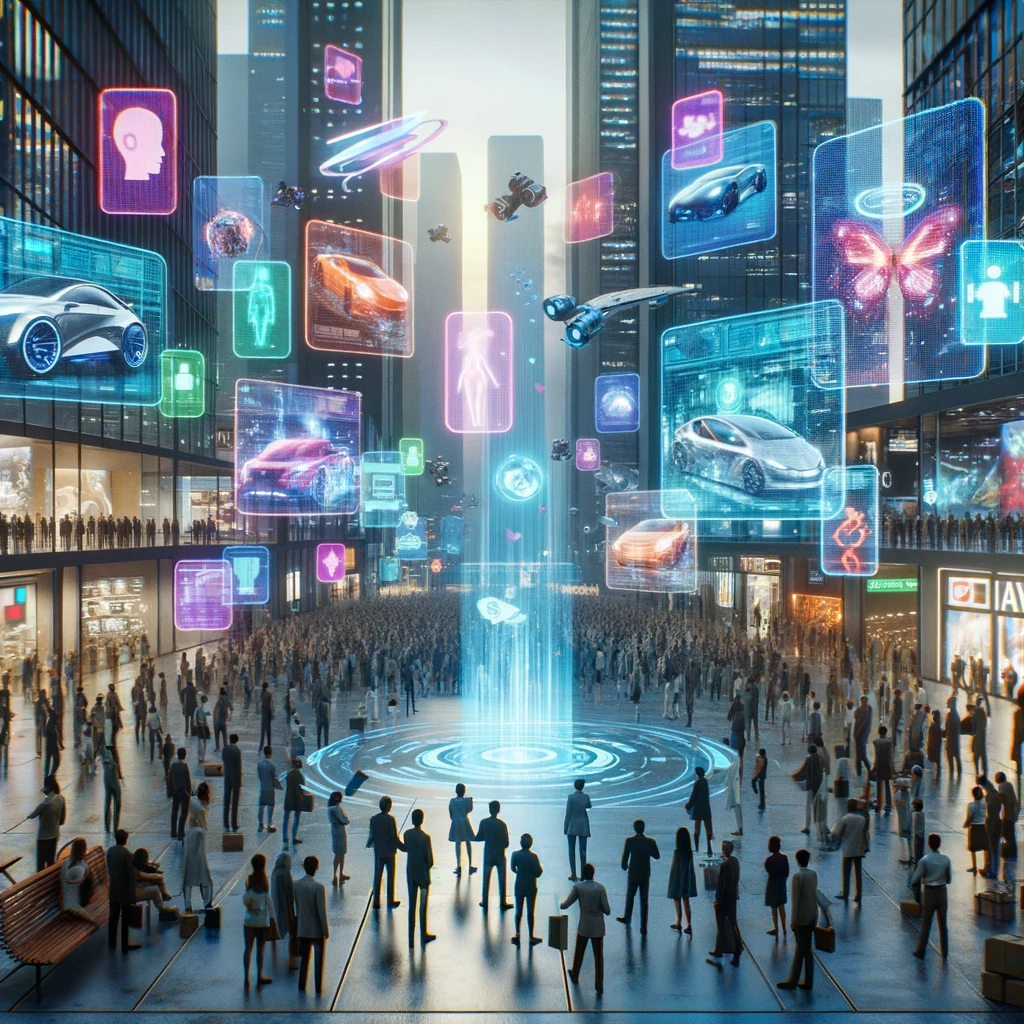
(image1)
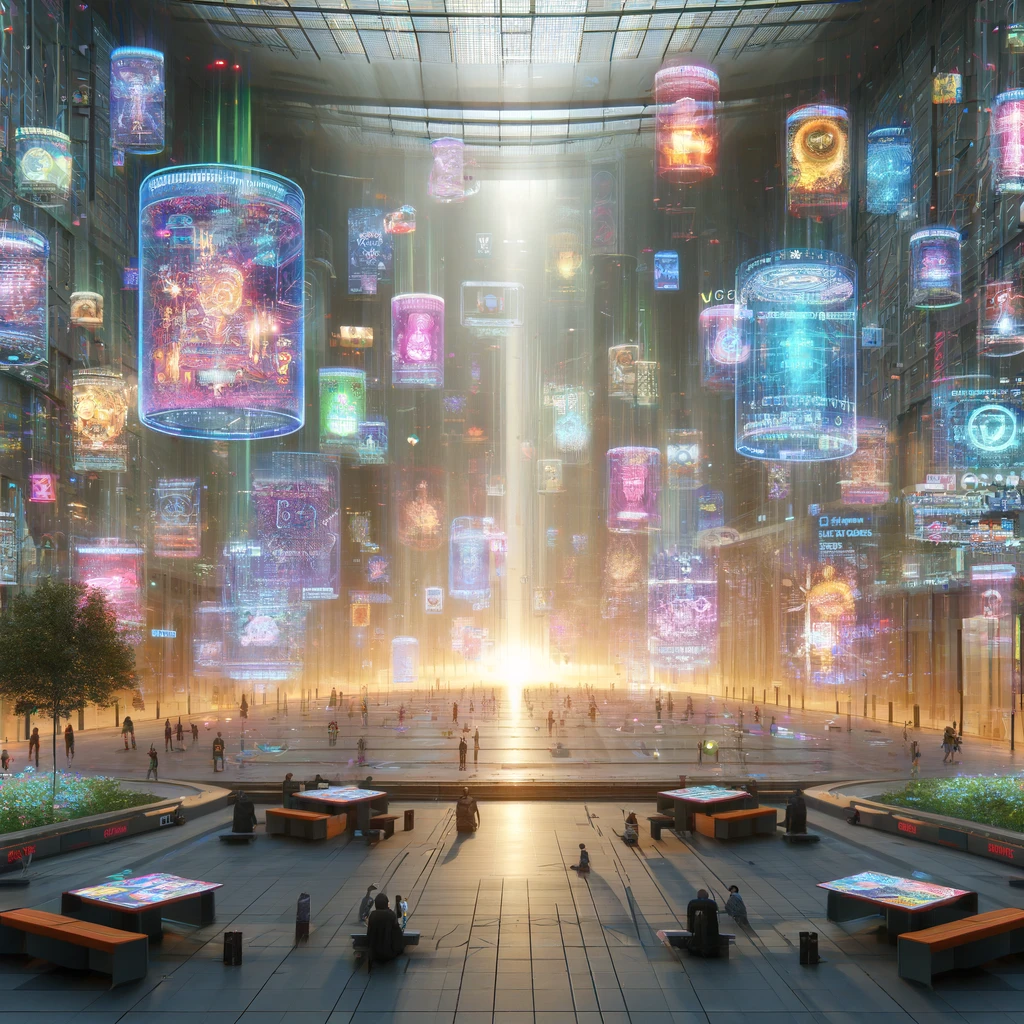
(image2)
Probable future
Research has shown that imagination and imagery combine to enable humans to conceptualise possible futures and their potential for realisation. Not only that, Spengler argues that imagination is the basis for making new connections and seeing new relationships. Therefore, imagining holographic advertising for 2030 should be based on today’s holographic interactive adverts, combined with a diffusion of the human imagination.
Holographic interactive advertising is an emerging form of advertising that uses holographic projection technology combined with touch interaction to achieve real-time interaction with the audience. It breaks the boundaries of traditional advertising and brings people a new vision and experience. Nowadays, people’s demand for interactive experience is growing, and the application of holographic technology will be more and more extensive. Therefore, considering the current pace of technological development and the market’s desire for novel experiences, holographic advertising technology is bound to become mainstream. the popularity of 5G and future 6G networks will provide the necessary bandwidth and speed for this technology to ensure a seamless holographic experience (Liu et al. 2021). Therefore, in 2030, holographic interactive advertising technology will be used in various industries and will lead to a boom in various industries that require holographic technology, such as the digital media industry (Liu et al. 2021). 3D animation, VR virtualisation, and 3D virtual game development will all be available to everyone by 2030 (Liu et al. 2021). By 2030, we will see holographic adverts seamlessly integrated into retail windows, public squares and even domestic spaces as part of everyday life.
As shown in image 3 below
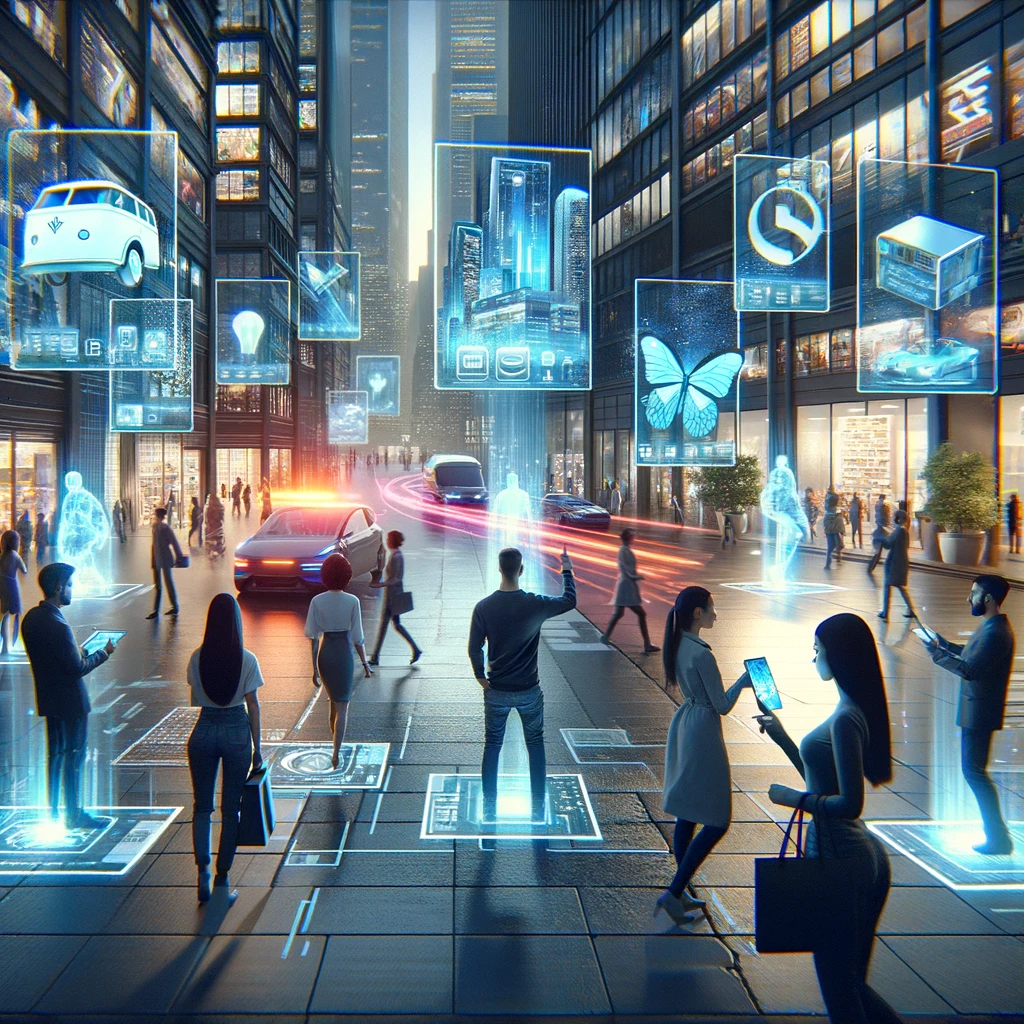
(image 3)
Preferable future:
By 2030, I envision holographic advertising to be ubiquitous, but integrated into our daily lives in a non-intrusive way. Whether at home, in the office or in public spaces, holographic adverts could intelligently adapt their display to the environment and personal preferences(Mobile Computing 2023). For example, when a person needs to make a travel plan, the holographic advert will appropriately present the right travel plan. Not only that, the adverts will not only be limited to the visual experience, but will also be able to have a two-way interaction with the consumer. Consumers can interact with the adverts through gestures, sounds and even thoughts. At the same time, with the development of holographic technology, the line between virtual and real will become blurred. Holographic advertising will be seamlessly integrated with real-world environments. This will open up a whole new way of creating and displaying adverts, creating unique promotional opportunities for brands.
As shown in image 4 below
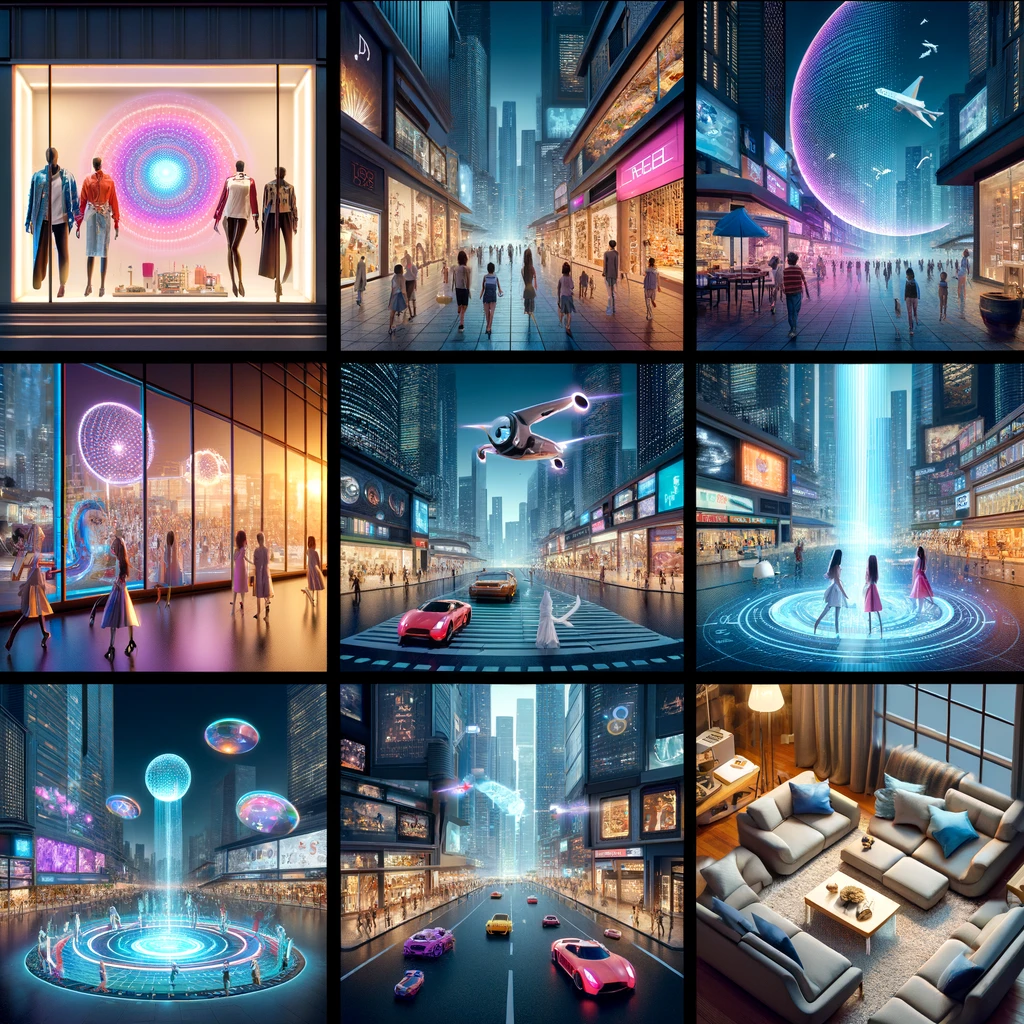
(image 4)
In Conclusion
Based on Wendell Bell’s futurological framework, we look at how holographic advertising technology might develop in 2030, where it is probabilistically headed, and the future we hope to realise. By looking into the future I think we will explore new developments in holographic technology in the future and build a world where holographic adverts coexist with the real world.
Reference list:
Aligica, P, D 2011, “Wendell Bell: The futurist,” Futures : the journal of policy, planning and futures studies, vol. 43, no. 6, pp. 563–564.
Holographic technologies as a way to attract investments. viewed 25th March
<http://www.immsp.kiev.ua/publications/articles/2022/2022_3/03_22_Tyschenko.pdf>
Liu, Y, Wu, S, Xu, Q & Liu, H 2021, “Holographic Projection Technology in the Field of Digital Media Art,” Wireless communications and mobile computing, vol. 2021, pp. 1–12. (Liu et al. 2021)
Mobile Computing, WC and 2023, “Retracted: Holographic Projection Technology in the Field of Digital Media Art,” Wireless communications and mobile computing, vol. 2023, pp. 1–1.
The Role of Modern Holographic Technology in Graphic Designs of Animated Advertising Campaigns. viewed 25th March
 Yining li